


Quick programming note: We’re packing 3 episodes into 2 weeks because we wanted everything you need to know for New Year’s Resolutions to get to you in time to still be helpful! We’ll be back on our regular schedule after this newsletter.
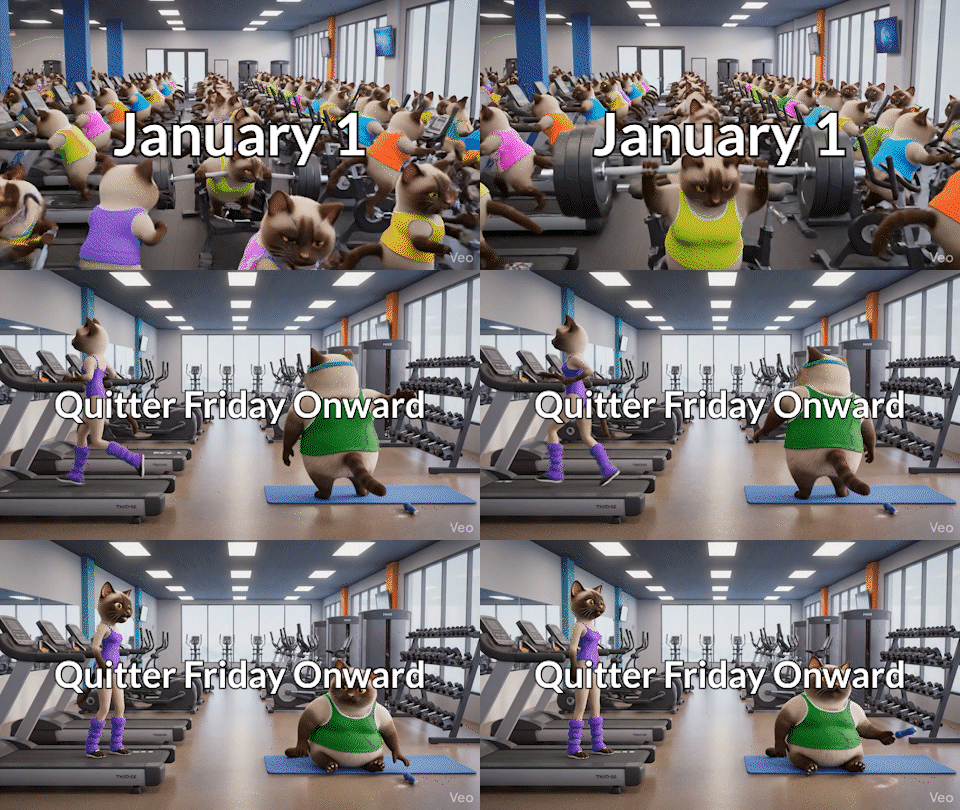
It’s the second Friday of January. If you made a New Year’s resolution, today’s the hardest day of the year to keep it.
Back in 2019, fitness app Strava coined the term “Quitter Friday” after analyzing their user data. They found that the second Friday of January shows the biggest drop-off in activity from the New Year’s bump. People are tired. Happy hour is calling. The gym can wait until Monday!
If you can push through today, you’re way more likely to make it another week. And another. And another. Until that resolution becomes an actual habit. So if you’re waffling on your resolution, let this be the signpost you need to stick with it!! Here are a few more ideas around habits and goal setting to help you get through Quitter Friday without quitting.
The “What the Hell” Effect
One of the biggest threats to your resolution is what researchers colloquially call the “What the Hell” effect, best pronounced in a thick Southern drawl.
In a famous study conducted at Northwestern University in 1975, researchers set up “an ice cream taste test” experiment where some of the participants were randomly chosen to drink a milkshake before eating ice cream. The researchers weren’t actually interested in whether or not drinking a milkshake changed the way the ice cream tasted; that was just a pretense so they could surreptitiously study the amount of ice cream people were eating.
Overall, the results were boring. People ate less ice cream if they drank a milkshake before they ate ice cream. Duh.
But the participants in the study who happened to be on a diet at that time did not behave the same way! Instead, dieters who first drank a milkshake ate more ice cream than the dieters who had not pregamed with a milkshake did! The thinking was probably something like: “I already had a milkshake. My diet’s ruined for the day anyway. What the hell, let’s have all the ice cream I want!”
After thinking about my own experiences with breaking diets, I’m not that surprised. When I’ve been trying not to snack, and I already lapsed with a cookie, I was way more likely to reach for a second one than I was to reach into the bag in the first place. What the hell, if I’m eating cookies why not eat a lot of them? Same for workout habits - as soon as I’ve “broken the chain,” I’ve failed, so why bother anymore?
Beating Perfect-or-Nothing
There are, fortunately, a number of ways to fight the “what the hell” effect and keep making progress toward your goal even when life gets in the way.
Structuring your goals to build in flexibility is one good option. Instead of “I will run every single day,” try “I will run five days a week.” That way, when you miss a day, you haven’t failed at all. And when you hit a six day or seven day week, it will feel really good and reinforce the positive feelings you associate with the goal.
There’s no character limit on how long a goal can be. If you need to interrupt your goal during a work trip, rewrite the goal to say that you will run when you’re home.
There’s also compelling research that shows that being kind to yourself makes it way more likely that you’ll pick back up your goal after a slip up. Beating yourself up doesn’t make you more motivated. To me, this is always a fine line to walk. Too much self-compassion makes me complacent, but apparently there is a Goldilocks amount. So instead of thinking that you’re “a weak person who can’t stick to anything,” think of yourself as “a runner who didn’t run today” or “a healthy eater who took a cheat day.”
The structure I used there was intentional. Incorporating your goal as a (small) part of your identity (“I am a runner” or “I am a healthy eater”) has a lot of positive knock-on effects. Aside from making it more likely that you will keep your goal, it also helps make your overall psyche more robust. And the part of your identity that’s associated with this goal doesn’t have to change because of one bad day.1
Finally, as we mentioned last time, preplan your comeback. Before you even slip up, decide what you’ll do when it happens. What’s your recovery plan? If you miss your morning run, what will you do instead?

The Quitter’s Comeback
If you’ve already fallen off the wagon, don’t abandon hope. Today is the best day to restart. It’s Quitter Friday - the gyms are already empty again!
But before doing exactly the same thing that didn’t work last time, take a few minutes to think about what went wrong. Was your trigger not strong enough? Was the habit too ambitious? Did life just get in the way? Then, use what you’ve learned from the lapse to build a better plan.
Maybe your trigger needs to change. Maybe you need to make things more visible. Or maybe you need to make the habit tinier or structure your environment a little bit differently so that it’s easier to do.
Whatever you decide, improve your habit and restart it. You’ll be glad you did in a few weeks.
Sleep and Reminders
If you’ve already optimized your triggers and your behaviors but are still finding it tough to keep your resolution, there are a couple other factors to consider.
First, there’s evidence that our sleep affects how well you can build habits. The light sleep stages help stabilize procedural memory, which is the kind your brain uses for skills and routines. Better sleep means stronger neural pathways for your new habits. The paper is kind of dense (what’s a sleep spindle? do you wind sleep threads on them?) but if you want to go deep, be my guest!
There’s also some compelling research around structuring reminders, in case you’re using technology to help you with your triggers. The research shows that the most effective technology-based reminders try to help you remember your trigger rather than your action itself. So, if your trigger is to run after lunch, you’re more likely to keep the habit if you set a reminder at the start of lunch that says “after lunch, go run!” rather than setting a reminder at 12:30pm that says “it’s time to go running!” when you’re supposed to actually head out. Neat!
Tip of the Week
If you’re still on track with your resolution, congratulations. Stay the course. Watch out for the “What the Hell” effect and remember that one slip doesn’t erase your progress.
If you’ve already fallen off? Welcome to the Quitter’s Comeback, picking up where you left off with better information about what works for you.
Either way, take a moment today to think about how your resolution is going and to update it to make it a little bit more robust in some way. If you don’t have any ideas, maybe incorporate a technology-based trigger reminder for the next few weeks, until the habit is fully cemented.
Don’t quit on Quitter Friday!
To learn more, listen to the full podcast episode.
Moah and I disagreed on this point about making resolutions part of your identity, and she won the argument. Listen to the episode to get her take in her own words.