


To borrow from the clickbait era of the Internet: What if there was an Ancient Chinese Secret that gave you an 18% chance of changing something about your life? It turns out that there is1 - just make a New Year’s resolution!
In general, people are deeply pessimistic about resolutions. We all know that guy who sneers about how “the gym’s totally empty by February 1, har har har!” Surveys show that only 3% of people believe New Year’s resolutions in general are very likely to succeed. Another 20% have some optimism, thinking resolutions have a “somewhat likely” chance of working out.
But when you ask people about how their own resolutions went, you get a dramatically different answer. After a year, 55% of resolution-makers feel like the resolution was a success in at least some way. And 18% report that their resolutions were a “total success!”
That gap tells you something important. Even when people don’t fully hit their goals, for example losing three pounds instead of the seven they set out to lose, they still moved in the right direction. The resolution gave them a push they wouldn’t have had otherwise. And they’re three pounds lighter than they would have been without it! That’s a big win!
Research on “Dry January” found something similar: people who committed to a month without alcohol reduced their baseline consumption for the rest of the year, even after they started drinking again. So even if a resolution isn’t a permanent solution or doesn’t solve all of your problems, it can trigger a lasting positive change.
Over the last ten years, I’ve had about ten “at least successful in some way” resolutions. Here’s hoping I can take my own advice and make this year “totally successful!”
The Fresh Start Effect
About 30% of people make a resolution on New Year’s Day in any given year, dramatically more than on any other calendar day. The most common resolution is saving more money, followed by a big cluster of health-related goals: exercise more, eat better, sleep better, be healthier. After that comes a bouquet of intellectual aspirations like learning something new, reading more books, or picking up a new language.
Katie Milkman, a professor at Wharton, wrote a book called How to Change that explores why certain moments make us more likely to attempt transformation. She calls it the “fresh start effect.”
Essentially, planning to change is most likely to work if it’s linked to what she called temporal landmarks. Temporal landmarks can be any point in time that carries special meaning. New Year’s Day is the biggest of these (after all, we start scrawling a new number at the end of all of our dates after we pop champagne), but it’s certainly not the only one. Your birthday works well. The start of a new month works a little bit. Even the beginning of a new week shows elevated rates of people trying to start something.
One of my favorite “landmarks” the research discusses is coming back from vacation. In addition to its temporal significance, vacations naturally provide a period of time where habits are necessarily different. You’ve been out of your routine, so you’re not fighting against the momentum of what you did yesterday. You’re starting fresh automatically.
The fresh start effect explains why people want to start things at these moments, and the data shows a slight boost in success rates when you begin at a landmark. But starting is relatively easy compared with following through.
The Problem with Resolutions
Most resolutions that fail are vague intentions, not specific behaviors. “Get more fit” is a worthy aspiration, but it’s not a good resolution. It’s not something you can actually plan to do on a Tuesday morning. And what does “get more fit” mean anyway? To me, maybe walking 30 minutes a day would count. To my crossfit-obsessed friend, a 30 minute lunch walk wouldn’t even register as exercise.
The resolution is too vague to act on, so it just floats around in your head until you forget about it. So a good resolution needs to tie your good intention to a specific behavior that you want to introduce. This is where habits come in.
The Science of Tiny Habits
The best research we’ve found on habit formation comes from BJ Fogg, who runs the Behavior Design Lab at Stanford. His book Tiny Habits lays out a framework that’s counterintuitive but effective. If you’ve heard of the book Atomic Habits, it’s based on the same framework.
Most people trying to build a new habit lean heavily on motivation. They psych themselves up, make vision boards, tell all their friends, visualize themselves succeeding, listen to motivational speakers.
Fogg’s framework is based on the acronym MAP: your likelihood of doing a behavior equals your Motivation times your Ability times a Prompt.
Motivation is the least controllable of the three factors. Sure, you can draw on pure motivation on January 1st, and even for a week or two after. But over time, the novelty will fade, the kids will bring home pestilence, you’ll have to travel for work, or would one piece of birthday cake really be that bad? It’s ice cream cake, come on!
So given that Motivation isn’t something you can bottle, you’ll want to increase Ability (make it easier to keep the habit) and find a really solid Prompt (something that reminds you to do it). To do that, you’ll want to simplify the habit and make it as easy as possible for you to do it, even on a bad day. Prompt-wise, you’ll want to tie it to some kind of behavior that you already do. The most common reason people fail at resolutions is really boring. They forgot. Life got busy, and one day they realized they hadn’t thought about their resolution in three weeks. A good prompt can help.
BJ’s representative example is flossing. People who fail at flossing habits often struggle because “floss your teeth” feels like a chore.
Fogg’s version? Floss one tooth. That’s the whole habit.
If you’re exhausted and need to get to bed, flossing one tooth takes two seconds. You kept your habit. And here’s the thing: 97% of the time, once you’ve got the floss out and it’s between two teeth, you’re going to finish the job anyway. But you don’t have to. The tiny version protects the habit on your worst days.
The second part of making it easy is setting up your environment. Don’t keep your floss in a drawer in the furthest corner of your house. Put it wherever you’ll actually see it.
BJ’s prompt for flossing is “after I brush my teeth” which is something that he already does every day, and something that naturally leads into flossing. It’s very easy to remember to grab the floss when you’ve already been working on your teeth.
Planning for Failure
The Fogg Behavior Model covers everything you need to know to form habits. But to make a resolution stick, you need one more thing. You have to plan to fail.
There’s a story that Jerry Seinfeld had a big calendar where he put an X every day he wrote, and his secret to writing was “don’t break the chain.” He later said he never actually did that. He just knew he needed to write every day. The “don’t break the chain” method sounds motivating in theory, but in practice, it can backfire. Once you miss a day, the chain is broken, and now you’ve got nothing to protect. “Don’t break the chain” is a recipe for a lost resolution. What you actually want is a system for getting back on track after you slip.

A year is a long time. A lot of things will happen. Even with strong motivation, a great prompt, and a simple tiny habit, there will inevitably be one day where the entire world comes together to block you from completing your new behavior. What happens then?
You’re most likely to be able to recover from a lapse in your habit if you’ve already preplanned what your recovery mechanism will be. When you’re choosing your resolution, spend a few minutes thinking through the most likely ways you could fall off the wagon. Then, think about how you’ll climb back up in each case. The higher the level of commitment for your recovery plan, the better. If you have a fitness goal and miss a day, booking a fitness class the day after will almost certainly bring you back.
There’s a myth that habits take 21 days to form. The actual research suggests it’s more like two months. The point is, you need to stick with it longer than you think. Those first few weeks aren’t enough. You have to plan for some bumps in the road along the way. Then, in March, you can put the habit on autopilot.
A Five-Step Process
We’ve taken the Fogg framework and our own addition and turned it into a five-step process you can follow.
Step 1: Pick a specific behavior.
Your intention is not a behavior. “Get fit” is an aspiration. “Walk for ten minutes after lunch” is a behavior. Find something you can commit to doing regularly that drives your intention forward. You have to translate the vague goal into a concrete action. Daily (or daily-ish) behaviors are easier to create habits around than “every few days” behaviors. Weekly ones can work if you can find a prompt that gives you an appropriate cadence.
Step 2: Make it easy.
First, make the behavior tiny. Instead of “go for a 30-minute walk,” try “put on my shoes and step outside.” Most of the time, once you’re outside, you’ll take the walk. But on terrible days when everything goes wrong, you can step outside, note that you kept your habit, and go back in. Second, reduce friction. Put your shoes by the door. Have your yoga mat already unrolled. Whatever you need for the habit should be as accessible as possible.
Step 3: Find a trigger.
The format is “After [existing routine], I will [new habit].” You don’t want to create a brand new neural pathway from scratch when you’re doing something that requires effort and commitment. Instead, attach to something that’s already automatic. After I eat lunch, I’ll step outside. After I turn off the living room light, I’ll floss one tooth. The trigger should be something you already do reliably, so you never have to remember.
Step 4: Celebrate.
This is the part I always forget, since it feels unnatural. I think that’s why so many of my habits have gone by the wayside over the years. Fogg argues it’s one of the most powerful pieces. You want to feel good about yourself when you do the behavior. It doesn’t have to be a pageant. His example is simply looking in the mirror and smiling. You could do a little fist pump. You could put on a favorite song. You could high-five a door. The point is creating a positive association with the behavior so your brain wants to do it again.
Step 5: Plan your reset.
Think through failure scenarios ahead of time. If your habit is an after-lunch walk and you’re at a conference with back-to-back sessions, what’s your plan? If you hurt your knee and can’t exercise for three weeks, how will you restart? You’ll want to make your reset as high-commitment as possible. Book a yoga class three weeks out. Put a calendar reminder for the day after your trip. Write yourself a note that says “I missed today, but I will do it tomorrow.” Anything is better than vaguely thinking “I should really start that again,” because that’s not enough to make you really start that again.
Two Examples
Let’s walk through how this works in practice.
Say your resolution is to get more fit. The specific behavior might be: after I finish eating lunch, I will put on my shoes and step outside. That’s the trigger (finishing lunch) attached to a tiny behavior (shoes on, step outside). Make it easy by keeping your shoes by the door. Celebrate with a high-five to the doorframe when you get back, or put on your favorite song while you drink a glass of water. Plan your reset: if you’re working from the office and coworkers drag you into a meeting right after lunch, you’ll do a five-minute walk after your last meeting of the day instead.
Let’s do a professional resolution too: you want to grow your network. Committing to going to an event every couple of months could work, but let’s find something daily, so we can make it more automatic. The behavior: after I close my work laptop, I will leave one comment on a LinkedIn post. It’s very tiny. You can just say “congratulations!” to whoever’s bragging about something on LinkedIn that day.
Do it at the end of the day so you don’t get sucked into the LinkedIn vortex when you should be working. Celebrate with a thumbs-up to yourself (LinkedIn’s already got the icon right there). Reset plan: if you forget, schedule a ten-minute calendar appointment for the next afternoon to remind you.
Founding Fathers and Resolutions
It’s an achievement to create a new habit. Creating a complete lifestyle transformation in one fell swoop, though, needs a lot stronger temporal milestone than a new date.
If you want a historical model for habit formation, look at Benjamin Franklin (He of the 35 illegitimate children, a Less Busy Lab recurring dispute!)
Franklin tracked himself against thirteen virtues: temperance, industry, order, and so on (not chastity, never chastity!) But even with thirteen goals, he only focused on one virtue per week. He’d rotate through all thirteen, giving each one dedicated attention before moving to the next.
This is why we recommend focusing on one habit at a time. You can still have multiple resolutions. Just stagger them. Use Boomerang to send yourself an email in March saying “time to start habit #2.” Put a task in GQueues and use our nifty new snooze feature to put it out of mind for two months. Stack your habits over time rather than trying to change everything at once.
Our Resolutions
In the spirit of practicing what we preach, here’s what we’re committing to.
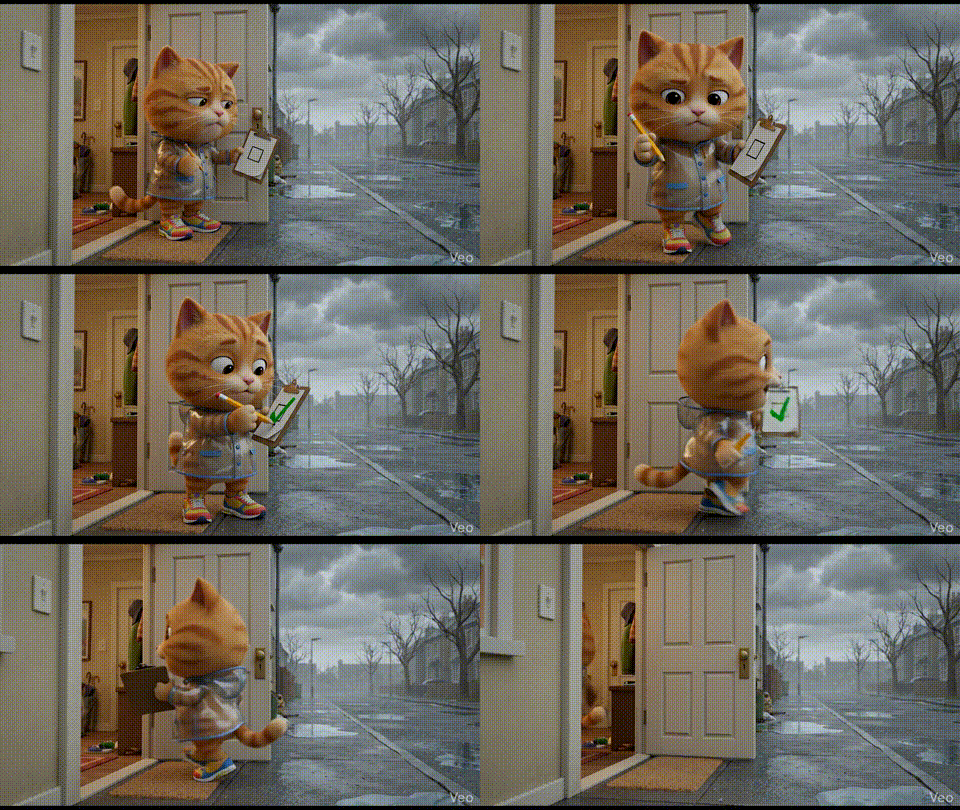
Moah’s intention is to sleep better, and the specific behavior is getting morning sunlight for at least ten minutes within the first hour of waking up. The trigger is the kids leaving for school at 8:30. When they go out the door, she’ll put on her jacket and shoes and go out too. Most days when she’s driving somewhere, the sunlight happens automatically. For rainy days, she’s got a nice raincoat that might provide enough motivation. Her celebration is the checkbox itself. Tracking is rewarding enough. And she’s getting sun stickers for her calendar as a Christmas present.
My own resolution is to read more this year. I don’t feel any guilt about the nights I spend my few minutes with no responsibilities playing video games, but I still spend a decent number of them doomscrolling. Reading a book - any book - would be a lot better!

My specific behavior will be reading just one page after putting the kids to bed. The trigger is the kids’ bedtime routine finishing. I typically read on my Kindle, so I can load the books into my phone as well so they’ll always be accessible. If I miss a night because we’re traveling or out late, I’ll read the page in the morning instead to get back on track - and I just committed publicly that I’d do it, so there’s a little extra juice in the commitment. Celebration-wise, I’ve still got a couple of days to come up with something better than a thumbs-up in the book’s direction, but that’s a solid default.
The Bottom Line
Resolutions are good, but they’re even better when you turn intentions into a repeatable behavior. Most of them fail not because people lack willpower but because they never turned the intention into a system. The five-step process gives you that system: pick a specific behavior, make it easy, attach it to a trigger, celebrate when you do it, and plan how you’ll get back on track when you slip.
Eighteen percent of people keep their resolutions for a full year. Follow this framework, and you’ve got a much better shot at being in that 18%. And stay tuned for our next episode. We’ll be back just in time for “Quitter’s Friday”—the day when most people abandon their resolutions—with extra motivation to keep you going.
Happy New Year! To hear the full discussion, listen to Episode 15 of Less Busy Lab. Have questions? Send them to questions@lessbusylab.com
It’s actually an ancient Babylonian secret. People have been making promises at the start of new years since the Akitu festivals in ancient Babylon, where they’d vow to the gods that they’d pay back their debts and return things they’d borrowed. You don’t want to let the gods down, especially not the god of inflicted death! The phrase “New Year’s resolution” first appeared in 1850, which is pretty ancient in its own right.