


You might want to set down your coffee for this one: unproductive meetings cost the average company $25,000 a year per white-collar employee. And it gets even worse - this research (from UNC Charlotte) was conducted in 2012, so that’s over $35,000 in today’s dollars! Bad meetings hurt efficiency, hurt morale, and grind projects to a standstill.
Since we acquired GQueues last year, we’ve been thinking a lot about how people manage projects. After 15 years, it’s nice to think about something that doesn’t involve email! Anyway, whether they’re remote, hybrid, or in-person, virtually every team we’ve observed relies on meetings to fill in communication gaps and make decisions. We’ve been thinking a lot about how to make software that’s built around this reality (stay tuned), and part of our research has been attending a lot of meetings at a lot of different organizations.
Some of these meetings could have been case studies in how to make the most of a meeting, with clear agendas going in, lively, focused discussions leading to changes in plans and better decisions during the meeting, and action items organized and prioritized on the back end. Most, though… well, they didn’t run that way at all.
Nobody thinks their meetings suck (organizers are substantially more likely to rate meetings as valuable than participants), but I’ll guarantee that at least some of your meetings do, in fact, suck. The best time to rework or cancel an unproductive recurring meeting is the first time it stopped being useful, but the next best time is today. And, as we discovered from conducting our own Meetings Defrag, it doesn’t take much effort to find out which ones those are and fix them.
Bad Meetings Are Energy Vampires
That $35k cost of bad meetings is really just the beginning.
Many of us spend an enormous amount of time in meetings – the highest 25th percentile of all workers (the data does not exclude frontline workers like retail cashiers) are in meetings for almost a full workday each week. When UNC performed their calculations, the cost of that time was the main focus of their calculations. But meetings-that-could-have-been-emails also disrupt people’s workdays, break up opportunities for focused time, sap morale, and slow down projects as people wait for meetings to make progress.
Microsoft’s Work Trend Index found that two-thirds of people feel they could skip most of their meetings and nobody would even notice. In other words, nobody is getting any value out of their presence in most of the meetings they attend. Not them, and not their colleagues. They’re in the meetings because of social pressure and FOMO, not because they’re contributing or learning anything useful.
In addition to the lost time in the meeting, the cost of interruption and lost focus for each one of those meetings is high too. Research on attention residue shows it takes roughly 20 minutes to cognitively recover from a typical meeting — and the worse the meeting is, the longer the hangover lasts. There’s an inverse relationship between how relevant a meeting is to your work and how long it takes you to get back to being productive.
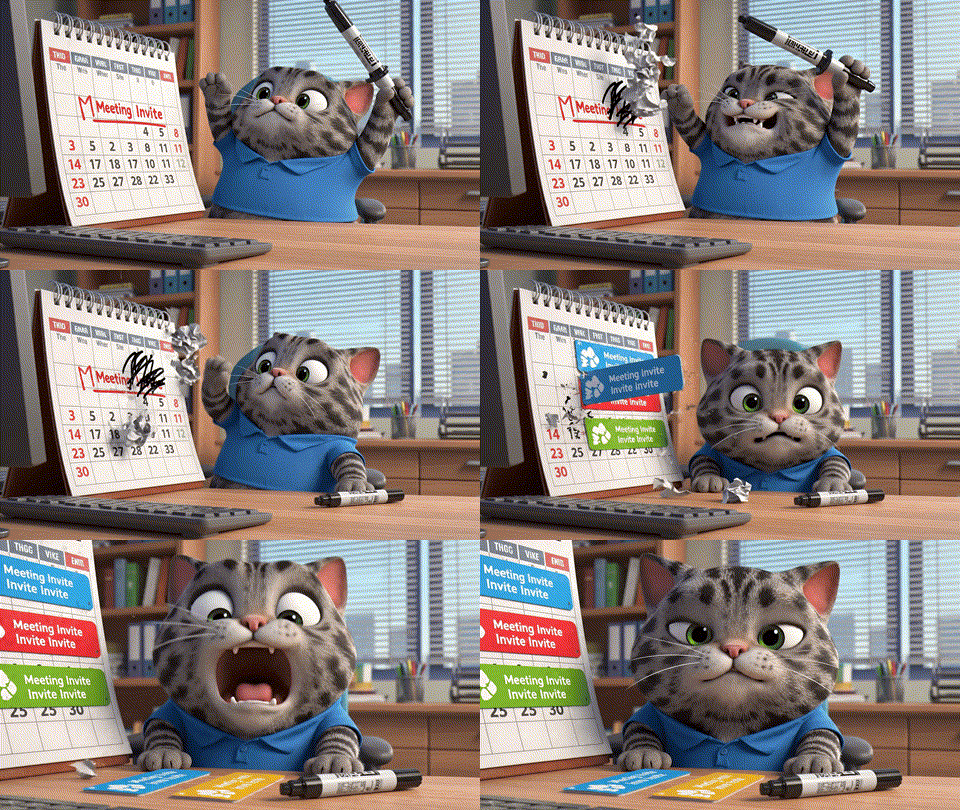
And worse yet, bad meetings are meeting hydras. Because the decision didn’t get made or the action item didn’t get logged or the critical information never got shared, each bad meeting is much more likely to spawn even more meetings. Like the monster from Greek mythology that grows two heads back every time one is cut off, evil begets evil!
What Makes a Meeting Good: The Research
Now that we’ve covered why bad meetings are so insidious, let’s talk about what makes a great meeting. One fantastic data source is Calendly’s State of Meetings Report. (NB: Their data is great, but if you’re looking for a better Calendly alternative, check out our Bookable Schedule product and embed your availability right inside your email! As always, Less Busy Lab is sponsored by Boomerang and GQueues 😁)
Calendly surveyed thousands of workers on what makes for a great meeting. Here were the high points:
1. Planning and decision making actually happens. This is the single biggest driver of perceived meeting failure — and it’s almost entirely preventable. The reason you’re together is to make decisions and line up action items.
2. Everyone’s there. The person who needs to make the decision and the people who have the information needed to inform the decision all need to be in the room for the meeting to be effective.
3. Strong follow-up. In many cases, meetings go like this: Things were discussed. Decisions were maybe made. And then everyone walked out and nothing was written down. Documenting the decisions and action items that were made ensures that the meeting is part of a process that actually brings goals to completion.
4. Agenda and pre-read happen. It’s crucial for people to understand the purpose of the meeting and to stay focused on it. Having an agenda and going in prepared make sure that the (very expensive) time everyone is at the same place at the same time is well spent.
If meetings are bad, fewer meetings are good, right?
In the spirit of holding good meetings, research finds that zero meetings isn’t a good target.
Researchers at Utah and Utah State found a curvilinear relationship between meeting load and effectiveness. Workers with no meetings at all tended to underperform. Workers in back-to-back meetings weren’t effective either. Peak performance lived somewhere in the middle, with enough meetings for cross-pollination of ideas and team connection, but enough uninterrupted time to make real progress on all those ideas. Fully async companies that eliminate meetings entirely see autonomy stay high but engagement decline.
Separately, research on no-meeting days found that engagement and productivity peak at four no-meeting days per week. We’ve sometimes aimed for this at Boomerang over the years, dedicating one weekday to as many meetings as possible. It’s a long, grueling day, but the rest of the week’s uninterrupted focus time made up for it.
Meetings aren’t the enemy. Bad meetings are. And the goal shouldn’t necessarily be having fewer meetings, it should be having better ones.
Four Meeting Types (And Why You Should Be Careful Mixing Them)
When we started exploring this space from a product standpoint, Manu (one of our investors) suggested reading Patrick Lencioni’s Death by Meeting. The framework he lays out makes a lot of sense and helped guide us as we evaluated how to make our own meetings better.
The core thesis of the book is there are four distinct types of meetings, and most bad meetings stem from mixing them together. Lencioni recommends building your schedule from this framework, and setting out 4 different recurring meetings.
1. The Daily Huddle (under 10 minutes). This quick and structured meeting is basically the “daily standup” that most of tech, including us, already do. The 3 questions everyone on the team answers each day are: what did you do yesterday, what are you doing today, and what’s blocking you? This meeting type is all about awareness, lightweight coordination, and manufacturing accountability.
2. The Weekly Tactical Meeting. This is where most low-medium stakes decisions get made and where more involved coordination happens. We also have had these meetings for years, one for each team (or department or function), with an occasional drop-in from someone on another team when there’s a project that needs input. This meeting’s deliverable is a set of action items and follow-ups.
The counterintuitive part is that Lencioni believes that weekly tactical meetings should not have a standing agenda, because a fixed agenda prevents people from raising what’s actually urgent that week. We’ve tried to balance this with a desire for structure by building the agenda asynchronously each week (the meeting doc is always available) as things come up.
3. The Monthly Strategic This 2-3 hour meeting is where big decisions happen: new markets, major investments, strategic pivots. The expectation is that everyone shows up prepared, and the meeting ends when the decisions are made, not after an hour or however long is scheduled. We typically have not had this meeting at a team level, and decisions that would be made here have usually gone into the quarterly or weekly meetings instead.
4. The Quarterly Offsite The really big-picture, long-horizon thinking. Get out of the building. We typically do this twice a year because we’re remote and travel is burdensome, supplementing with a remote meeting for the quarters where we don’t have an offsite.
The problem Lencioni illustrates is that many organizations smash all four types into a single recurring weekly meeting. Client logistics, budget debates, team morale, and the five-year strategy can’t all be crammed into 60 minutes piecemeal. The big picture decisions don’t get resolved or get made in a slapdash way, and by the time the tactical items come up, everyone’s too worn down to get the details right. So people leave feeling vaguely unsatisfied, and the organization doesn’t work as well as it could.
Extreme Meeting Defrag
We like to think of auditing the standing meetings on your calendar as a “meeting defrag.”
In case that reference is lost on you: in the not-so-long-ago old days of spinning computer hard disk drives, it was necessary to “defragment” the computer’s storage from time to time. As you used the computer — saved things here, accessed files there, deleted an old version of something — the hard disk drive accumulated fragments of data in random places. A periodic “defrag” would rearrange your data on the disc into more efficient usage of space and clean up these errant bits of digital debris.
When you audit your meetings, think of doing the same thing to a weekly or monthly view of your calendar: you’re cleaning up the pieces of things that no longer serve a purpose and reorganizing it all into a more efficient use of your time.
With that in mind here are a couple tales of organizational meeting defrag.
Approach 1: The Nuclear Option (Shopify’s Playbook)
On New Year’s Day 2023, Shopify deleted every recurring meeting with three or more attendees. One-on-ones survived, but practically everything else was wiped out. After deleting approximately 12,000 calendar events, they gave employees two weeks to rebuild only what was genuinely necessary.
The result: Shopify declared victory, reported significant cost savings, and ended up with substantially fewer meetings than before. They also implemented a no-meeting Wednesday and restricted large meetings (50+ people) to a single six-hour window on Thursdays.
The Shopify approach worked for them because it forced a reckoning with meeting creep. Meetings are easy to add, but we often forget to go back and clear them out when they stop being useful. Nobody schedules a meeting with the intention of having it be useless. But they just keep showing up, week after week, because stopping requires someone to take action. Six months later, the meeting’s still there, but the value isn’t.

We thought digging in a bit more on the 50+ person meeting rule might be a good idea too - a recurring 50+ person meeting can’t be a meaningful dialog, it’s a broadcast. So maybe consider recording and distributing the content if there’s not value in having it be live.
Approach 2: Batch by Context, Not Just by Day
Most meeting defrag software groups meetings together back-to-back to create large blocks of uninterrupted maker time, kind of implementing the ideas in Paul Graham’s essay on maker time vs. manager time. As we discussed in our episode on flow, it’s a good idea to create that space. But there’s a further refinement worth considering: batching by meeting type and context, not just by day.
The idea is that your brain has to load a different operating mode for different kinds of conversations. Managing people requires a different cognitive frame than negotiating with vendors, which is different from deep product strategy. When you switch between those modes in rapid succession, you pay a context-switching tax on every transition.
One approach that works well for some people is to designate different days for different kinds of engagement. One-on-ones and people management on Mondays. External vendor or partner meetings on Tuesdays. Protected maker time mid-week. Team recurring meetings on Thursdays.
It doesn’t work for everyone. Batching similar meetings back-to-back can cause bleed-over, especially with emotionally demanding conversations like performance or coaching discussions. But if you’re the type of person it does work for, it can be a powerful tool.
The Meeting Audit
There’s a reason that “the nuclear option” isn’t usually the one people reach for when they want to fix a problem! So unless your schedule is so overgrown with meetings that the reset button is the only viable approach, we recommend doing a meeting audit instead.
The playbook is really simple: ask everyone on your team to list their recurring meetings and describe in a sentence or two what they get out of each one. Keep it open-ended, and don’t bother with stuff like 1-to-5 rating scales.
We did this, and the findings were revealing in unexpected ways. Some team members completely forgot to mention certain recurring meetings, meaning that they don’t even get enough out of it to remember that they attend. If a meeting doesn’t show up in someone’s mental model of their week, it’s not providing value for them.
Others mentioned they attend certain meetings silently, without contributing, because someone asked them to cover while they were out on leave or because they needed to be there for a short time to contribute to a specific project. And then they never stopped coming. There is real social pressure to never say no to a meeting invitation and to tell the rest of the participants that the meeting isn’t adding value.
The audit showed us one more surprise: meetings where the format, attendees, and duration are the same, but whose actual value has shifted underfoot. It turned out a huge portion of the value of our daily coordination meeting was that the running chat sidebar was providing a social touchpoint for our remote team. Understanding the current function of a meeting, not the original one, helped us figure out where to optimize.
The Four-Question Checklist: Is This Meeting Earning Its Place?
When evaluating any recurring meeting, here are four questions to ask, whether you’re running an audit or just doing a gut check:
Are decisions being made? Is there just discussion, or are decisions actually made in this meeting?.
Is anyone doing anything differently because of what happens here? If everyone walks out and continues exactly as before each week, the information exchanged had no operational value.
Are new viewpoints or perspectives being shared? An underrated value prop for a meeting may be understanding where colleagues stand, what they’re worried about, and what they’re excited about. The value of some meetings may be information gathering that will inform a later one.
Is there genuine social value? For remote and hybrid teams especially, the human connective tissue of regular face time matters more than people want to admit. The harms of a “no chitchat” meeting culture may exceed the benefits in today’s world.
If a recurring meeting can’t satisfy at least one of these, cancel it. If it’s trying to satisfy all four at once and doing none of them well, split it up.
Tip of the Week: Run a Meeting Audit
Send a short, open-ended survey asking team members to list their recurring meetings and describe what they get out of each one.
Look for the signals: meetings people forgot to mention, meetings people attend silently, meetings that have drifted from their original purpose.
Apply the four meeting types from Death by Meeting and our four-question value checklist to your recurring calendar. Are your meetings serving a purpose, and are they in the right format for that purpose?
Repeat at regular intervals. Meeting creep is relentless. You don’t need a full audit every year, but you should check in periodically and ask: what has accumulated on our calendar that’s no longer earning its place?
In about the same amount of time it takes to run one bad meeting, you can give your whole team a calendar where every meeting has a reason to exist, and everyone in the room knows what it is.
This post is based on Episode 19 of the Less Busy Lab podcast. Listen to the full episode for more, and subscribe to hear more about productivity from Alex and Moah, co-founders of Boomerang. Find it on Apple Podcasts, Spotify, or wherever you listen.